
Introduction
Pamela Rothpletz-Puglia
Why Context Matters in Health
Health is never simply a matter of biology, nor can it be reduced to psychology alone, nor can it be fully explained without attention to social conditions. Every patient story, every public health trend, and every medical outcome emerges within a web of intersecting influences. The biopsychosocial model, first articulated by George Engel in 1977, offered a revolutionary alternative to the dominance of biomedical thinking by insisting that health can only be understood in context. This book begins from that insight and expands it: context is not just important—it is the mother of everything.
From Reductionism to Integration
The history of medicine has often leaned toward reductionism. The biomedical model, while powerful in advancing diagnostics and therapeutics, has at times overlooked patients’ lived experiences and the social and cultural contexts in which they live. By contrast, the biopsychosocial model integrates biological mechanisms, psychological processes, and social environments, offering a holistic picture of health. This shift is not merely academic; it reshapes how clinicians care for individuals, how researchers frame questions, and how educators train future health professionals.
The Aim of This Book
This text is designed for undergraduate and graduate students embarking on careers in the health sciences. It aims to demonstrate how the biopsychosocial model can be both understood and applied through qualitative inquiry. By exploring health drivers across biological, psychological, and social domains, students will see how meaning, narrative, and lived experience complement quantitative measures and clinical assessments. Please note: We are developing the second half of the book on qualitative methods, so this is not visible yet.
Why Qualitative Methods?
Qualitative research methods are essential for studying context because they capture dimensions of health that are often invisible in statistical data: the way patients narrate suffering, how families interpret illness, the role of cultural beliefs in treatment decisions, and the impact of policies on everyday life. These methods allow us to interrogate the “how” and “why” of health experiences, not just the “what.” They highlight contradictions, complexities, and possibilities for change that numbers alone cannot.
Structure of the Book
The book unfolds in two sections. The first section includes five chapters about the Biopsychosocial Drivers of Health:
- Foundations of the Biopsychosocial Model traces its origins, contrasts it with other models, and sets the stage for a holistic perspective.
- Biological Drivers reviews genetics, physiology, and neuroscience while situating them in context.
- Psychological Drivers investigates cognition, emotion, coping, resilience, and theories of behavior change.
- Social Drivers explores structures of inequality, cultural influences, social support, and global health disparities.
- Biopsychosocial Interactions in Everyday Life illustrates how these drivers interweave in real-world cases.
The second section of the book is UNDER DEVELOPMENT and will cover qualitative and mixed methods research and evaluation approaches embedded in the biopsychosocial model.
Students engaging with this material will be challenged to think beyond categories, to resist simple explanations, and to cultivate an integrative perspective. The biopsychosocial model asks us to consider complexity not as an obstacle but as a source of insight. By grounding health in context, we are better equipped to design programs, research, deliver care, and build systems that are not only scientifically rigorous but also attuned to human meaning.
In the sections ahead, we invite you to explore how context shapes health outcomes, how qualitative methods illuminate patterns of resilience and vulnerability, and how your future practice can carry forward the central lesson of this book: context is the mother of everything.
Media Attributions
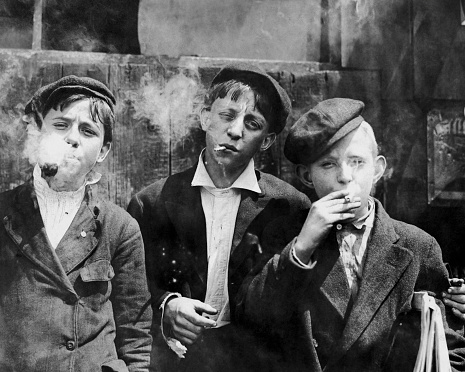
- May 9, 1910 – Young newsboys smoking on a St. Louis, Missouri street. Photo by Lewis Hine. © Lewis Hines is licensed under a All Rights Reserved license
