
1 Chapter 1: Foundations of Contemporary Health Science and Practice
Pamela Rothpletz-Puglia and Frank Giannelli
Health as a System: The Biopsychosocial Model and Its Modern Adaptations
An integrative framework for health science research and practice
| 🎯 Learning Objectives
By the end of this chapter, you will be able to: 1. Explain the key assumptions and limitations of the biomedical model. 2. Describe Engel’s biopsychosocial model and its three core domains. 3. Articulate how biological, psychological, and social factors interact to shape health. 4. Compare major modern frameworks (NIMHD, WHO, Healthy People 2030, Life Course theory) and their extensions of the biopsychosocial model. 5. Apply these frameworks to real-world health scenarios and health equity challenges. |
Introduction
Health is a complex tapestry woven from biological, psychological, and social threads. Yet for much of the twentieth century, medicine operated as though a single thread — biology — was sufficient to explain the whole cloth. The biopsychosocial model, first articulated by psychiatrist George Engel in 1977, fundamentally challenged this assumption. Engel insisted that health cannot be understood solely in biological terms, arguing that psychological states and social environments shape illness and recovery just as powerfully as physiological processes do. This integrative model revolutionized medicine by broadening the lens through which clinicians, researchers, and educators view health — emphasizing the dynamic interplay among body, mind, and society.
Engel’s model arose from a pointed critique of the reductionism embedded in mainstream biomedicine. The dominant biomedical paradigm, powerful as it was in advancing diagnostics and treatment, tended to reduce illness to isolated biological factors, neglecting psychological distress, social circumstances, and the cultural meanings that shape how illness is experienced and managed. Engel proposed a more holistic framework grounded in systems thinking, in which health emerges from interactions at multiple levels simultaneously. In doing so, he reframed health not as the mere absence of disease, but as the product of intersecting forces spanning genes to neighborhoods.
Consider a patient recovering from cardiac surgery. The surgical outcome depends not only on technical precision but on whether the patient is managing depression, whether family members are available to assist with recovery, and whether the patient can afford prescribed medications. This is the biopsychosocial model in action: biology, psychology, and social context are inseparable.
| 💡 Key Concept: Systems Thinking
Engel drew on general systems theory, which holds that complex phenomena cannot be understood by reducing them to isolated components. Just as understanding traffic patterns requires knowing more than the mechanics of individual cars, understanding health requires knowing about the individual within their psychological and social environment. |
Since Engel’s seminal work, the biopsychosocial model has been expanded and adapted by major health organizations and research frameworks to address contemporary challenges. The National Institute on Minority Health and Health Disparities (NIMHD) Research Framework extends Engel’s insights by explicitly incorporating multi-level determinants of health disparities — including systemic racism and economic inequality — as critical influences on minority health. The World Health Organization (WHO) conceptualizes health through a model that embraces social determinants such as education, employment, housing, and environmental conditions, championing a holistic, multi-sectoral strategy for global health promotion. Healthy People 2030, the United States’ national health policy initiative, operationalizes biopsychosocial principles through objectives that prioritize social determinants of health, health equity, and well-being. Finally, Life Course and Cumulative Disadvantage theory enriches this perspective by demonstrating how biological insults, psychological stressors, and social adversities accumulate across an individual’s lifespan, widening health outcome gaps.
Together, these modern adaptations reinforce and extend Engel’s foundational framework, driving it beyond its original clinical context into broad research, policy, and practice domains. This chapter aims to illuminate the evolution of the biopsychosocial model from Engel’s pioneering ideas to the present-day frameworks that guide health research, policy, and practice worldwide.
Why Do We Need Models and Frameworks?
Imagine arriving in an unfamiliar city without a map. You might eventually find your destination, but only after wasting effort and wrong turns. Theoretical models and frameworks serve as maps for health science: they orient investigators, clarify relationships among variables, and guide practitioners toward effective action. Without them, research is fragmented, interventions miss their targets, and important determinants of disease go unexamined.
1. Structure and Organization
Health science regularly confronts multifactorial problems in which dozens of variables interact in non-linear ways. Models provide:
- Conceptual organization — categorizing variables into coherent domains so researchers can distinguish signal from noise.
- Clear boundaries — defining what is included within a study or intervention and what lies outside scope.
- Relational maps — illustrating directional pathways, feedback loops, and mediating mechanisms.
2. Understanding and Explanation
Models do more than organize — they generate insight. A good theoretical framework:
- Simplifies complexity without losing explanatory power.
- Produces testable hypotheses that can falsify or confirm the model.
- Reveals mechanisms — the “how” and “why” behind observed health patterns.
3. Consistency and Standardization
Robust science requires reproducibility. Frameworks contribute to this by establishing a shared vocabulary across institutions and disciplines, guiding consistent measurement approaches, and standardizing intervention designs so that findings from one setting can be meaningfully compared to another.
4. Prediction and Intervention Design
Ultimately, health science exists to improve outcomes. Models enable researchers to predict which populations are at elevated risk, identify the most influential targets for intervention, and specify the mechanisms of action that interventions must engage. Without this theoretical grounding, programs may address symptoms rather than causes.
5. Translation and Implementation
Even the most rigorous findings are worthless if they cannot be put into practice. Models facilitate translation by providing implementation roadmaps, anticipating barriers and facilitators, and embedding sustainability considerations from the outset.
| 📌 Practical Takeaway
A framework is not a constraint on creativity — it is the infrastructure that makes creative, rigorous science possible. Just as an architect works within structural principles to design a building that stands, health scientists use frameworks to design studies and interventions that withstand scrutiny. |
The Biomedical Model
The biomedical model dominated Western medicine for more than three centuries, producing extraordinary advances in understanding infectious disease, surgical technique, pharmacology, and diagnostic technology. To appreciate why the biopsychosocial model was a genuine paradigm shift — and not merely an addendum — it is essential to understand the structure and limits of what it replaced.
Core Assumptions
The biomedical model rests on five interlocking assumptions that shaped everything from how diseases were classified to how patients were spoken to in clinical encounters:
| Assumption | What This Means in Practice |
| Mind-Body Dualism | The mind and body are separate entities. Health care providers address the physical body; psychological and social factors are considered outside the medical domain. |
| Reductionism | Complex phenomena are reduced to their smallest biological components — a gene, cells, or receptors. The whole person is less important than the malfunctioning part. |
| Biological Objectivity | Disease is an objective, measurable phenomenon, independent of the patient’s subjective experience of suffering. |
| Universalism | Diseases present identically regardless of who the patient is, where they live, or their cultural context. |
| Medical Authority | Health care providers hold expert knowledge; patients are largely passive recipients of diagnosis and treatment. |
Table 1. Core assumptions of the biomedical model and their practical implications.
Strengths
Biomedical thinking underpinned some of the most transformative achievements in human history. It would be a mistake to dismiss it entirely:
- Exceptional efficacy for acute, infectious, and traumatic conditions — antibiotics, vaccines, emergency surgery.
- Rigorous diagnostic frameworks that enabled standardized, evidence-based treatment protocols.
- Development of technologies — imaging, genomics, molecular therapies — that revolutionized diagnosis and prognosis.
- A foundation of scientific rigor that remains essential even in more integrative frameworks.
Limitations
However, as chronic, complex, and socially patterned diseases came to dominate the global burden of illness, the biomedical model’s limitations became increasingly consequential:
- It neglects psychosocial factors such as depression following a heart attack, poverty’s effect on hypertension management, or trauma’s relationship to autoimmune disease.
- Its focus on disease rather than health means that prevention is secondary and that health promotion is largely absent.
- The passive patient role undermines adherence, shared decision-making, and person-centered care.
- It is poorly equipped for chronic conditions like diabetes, chronic pain, or mental illness, which are shaped by biology, behavior, and social context simultaneously.
- It can lead to overmedication and over technologization, treating modifiable lifestyle and social determinants with pharmaceuticals instead.
| 🔎 Clinical Illustration
A 52-year-old patient with uncontrolled Type 2 diabetes presents repeatedly to the emergency department. The biomedical model prescribes medication adjustment. The biopsychosocial lens reveals she lives in a food desert, works two jobs (leaving no time for exercise), and is managing untreated depression that undermines adherence. Biology cannot be fixed without addressing psychology and social context. |
| Feature | Biomedical Model | Biopsychosocial Model | |
| Definition | Focus on Biological Factors | Integrates biological, psychological, and social factors | |
| Focus | Disease and Pathology | Patient as a whole | |
| Approach to Treatment | Primarily pharmacological | Multidisciplinary approach | |
| Role of the Patient | Passive recipient | Active participant | |
| Diagnosis | Based on laboratory tests | Incorporates lived experience | |
| Limitations | May overlook other drivers | Complex to implement | |
| Examples of Application | Treatment | Management | |
| Patient Outcomes | Symptom relief | Overall wellbeing |
Table 2. Side-by-side comparison of the Biomedical and Biopsychosocial models across key dimensions.
Engel’s Biopsychosocial Model
In 1977, George Engel published a paper in Science titled “The Need for a New Medical Model: A Challenge for Biomedicine.” The paper was not merely a critique of existing practice; it was a blueprint for a fundamentally different way of understanding health. Engel proposed that medicine must reconceptualize the patient not as a broken biological machine, but as a person embedded within psychological experience and social context. He called this the biopsychosocial model.
The model holds that health and illness emerge from dynamic interactions among three domains: the biological, psychological, and social. These domains are not independent compartments but interpenetrating systems. A change in one reverberates through the others. This systems perspective was radical in 1977 and remains generative today.
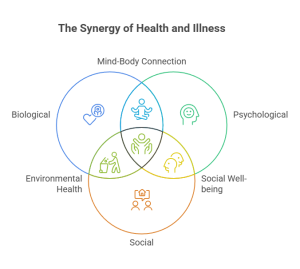
Figure 1. The three domains of the Biopsychosocial Model. Health and illness emerge from their intersection.
The Biological Domain
The biological domain encompasses all physical and physiological aspects of health. This includes genetic predispositions and inherited disease risk, physiological processes across organ systems (neurological, endocrine, cardiovascular, immune), anatomical structures, biochemical processes, immune responses, and the pharmacodynamics of medications. Far from diminishing biology, the biopsychosocial model situates biological factors within a broader web of influence.
- Example: A genetic variant increasing inflammatory cytokine production may predispose someone to depression, but whether that variant is expressed depends on environmental stressors (epigenetics).
- Example: Neurological sensitization underlies chronic pain, but the pain experience is amplified or attenuated by psychological state and social support.
The Psychological Domain
The psychological domain addresses the mental and emotional dimensions of health. It encompasses cognition — beliefs, expectations, and interpretations of symptoms; emotions including fear, grief, hope, and anxiety; behavioral patterns and health habits; coping strategies and resilience; personality and self-efficacy; and the presence or absence of mental health conditions.
- Example: A cancer patient’s belief that treatment will be effective (positive health locus of control) is associated with better adherence and improved survival.
- Example: Chronic anxiety activates the hypothalamic-pituitary-adrenal axis, elevating cortisol and suppressing immune function over time.
- Example: Depression following myocardial infarction significantly predicts 12-month cardiac mortality — independent of physiological disease severity.
The Social Domain
The social domain recognizes that health is not produced solely within individual bodies but within social environments. It includes socioeconomic status (income, education, occupation), social support networks, cultural norms and beliefs about health, access to healthcare, environmental exposures, neighborhood conditions, and experiences of discrimination and marginalization.
- Example: Patients with strong social support networks recover more quickly from surgery and report lower pain intensity — likely through both psychological and neuroimmunological pathways.
- Example: Residential segregation concentrates poverty, environmental toxins, and limited healthcare access, explaining substantial portions of racial disparities in hypertension and infant mortality.
- Example: Cultural beliefs shape health-seeking behavior, what counts as illness, when to seek care, and which treatments are acceptable, all of which vary across cultural contexts.
Domain Interactions and Syndemic Theory
The most powerful insight of the biopsychosocial model is not the three domains themselves but the recognition that they interact dynamically. Consider:
| Interaction | Clinical Example |
| Biological ↔ Psychological | Chronic pain drives depression and anxiety; depression amplifies pain sensitivity through shared neurobiological pathways (central sensitization, reduced serotonin). |
| Biological ↔ Social | Genetic predisposition to hypertension is activated by environmental stressors; neighborhood violence and discrimination trigger chronic activation of stress-response systems. |
| Psychological ↔ Social | Social isolation worsens depression; strong social support buffers against the mental health effects of adversity — and against physiological stress responses. |
| All Three Domains | A child raised in poverty (social) experiences chronic stress (psychological) that disrupts cortisol regulation and immune development (biological), increasing lifetime risk for both mental and physical chronic disease. |
Table 3. Bidirectional interactions across the three biopsychosocial domains.
Syndemic theory extends this logic further. Coined by medical anthropologist Merrill Singer, a syndemic occurs when two or more diseases cluster in the same population, interact biologically to worsen outcomes, and are driven by shared harmful social conditions such as poverty or discrimination. The COVID-19/obesity/diabetes syndemic in low-income communities is one prominent example: food insecurity (social), metabolic dysregulation (biological), and chronic stress (psychological) compound one another in ways that neither the biomedical model nor any single-domain intervention can address.
Clinical Applications
The biopsychosocial model transforms clinical practice in concrete ways:
- Comprehensive assessment: Providers screen not only for biological symptoms but for depression, social support, housing stability, and food security.
- Individualized treatment: The same diagnosis may require different treatment plans depending on a patient’s psychological resources and social context.
- Interdisciplinary collaboration: All kinds of health care professionals must work together since no single discipline owns the full picture.
- Prevention focus: By identifying upstream social and psychological determinants, interventions can interrupt disease trajectories before biological thresholds are crossed.
Modern Adaptations of the Biopsychosocial Model
Engel’s original model was primarily a clinical framework. It was a guide for how individual providers approach individual patients. Over the subsequent five decades, it has been expanded into population-level research frameworks, national health policy initiatives, and global public health strategies. Each of the four frameworks examined below builds on the biopsychosocial foundation while extending it in a distinct direction.
National Institute on Minority Health and Health Disparities (NIMHD) Research Framework
The NIMHD Research Framework represents the most explicit operationalization of the biopsychosocial model for health disparities science. It recognizes that minority health inequities are not simply the result of individual biological differences or behavioral choices but are produced by interlocking systems operating across multiple levels of society.
Please take a look at the framework here: https://www.nimhd.nih.gov/resources/research-framework/nimhd-research-framework-details
The framework organizes determinants across four levels:
- Individual: Genetics, physiology, health behaviors, and access to care — shaped by, but not reducible to, broader social forces.
- Interpersonal: Family relationships, peer networks, social support, and direct experiences of discrimination.
- Community: Neighborhood quality, availability of healthy food, green space, safe streets, and community norms around health behavior.
- Societal: Systemic racism, economic policy, political representation, and structural inequalities in education and employment.
The NIMHD framework is distinctive in insisting that health disparities are not accidental; they are produced by systems. Interventions that target only the individual level (e.g., health education programs) without addressing structural factors are unlikely to close persistent gaps. This framework redirects research questions toward the societal and community levels, asking not merely why individuals are sick, but why entire populations bear disproportionate burdens of disease.
| 🔬 Research Implication
A NIMHD-guided study on hypertension in Black Americans would not simply measure blood pressure and prescribe antihypertensives. It would investigate structural racism, residential segregation, chronic stress from discrimination, neighborhood food environments, and healthcare access as co-determinants of cardiovascular risk, and would design multi-level interventions accordingly. |
World Health Organization (WHO) Public Health Model
The World Health Organization’s framework on social determinants of health (SDH) aligns closely with Engel’s vision while applying it at the population and global level. The WHO framework identifies the “conditions in which people are born, grow, live, work, and age” as the fundamental drivers of health and health inequity.
The WHO framework recognizes that health is not simply the responsibility of health systems — it requires action across education, labor, housing, agriculture, transportation, and environmental policy. This multi-sectoral approach acknowledges that a physician can prescribe better nutrition but cannot create a grocery store in a food desert. Social determinants must be addressed by social policy.
- Key determinants highlighted by WHO include income and social protection, education, unemployment and job insecurity, working life conditions, food insecurity, housing, basic amenities and the environment, early childhood development, social inclusion and non-discrimination, structural conflict, and access to affordable health services.
The WHO framework is also notable for explicitly naming structural inequities — including racism and gendered power — as upstream determinants that produce downstream patterns of exposure and vulnerability. This represents a significant advance over models that treat social factors as contextual “background” rather than as fundamental causes.
Healthy People 2030
Healthy People 2030 is the United States’ science-based national health promotion initiative, now in its sixth decade. It establishes measurable objectives across five key domains of social determinants: economic stability, education access and quality, healthcare access and quality, neighborhood and built environment, and social and community context.
What makes Healthy People 2030 distinctive as a biopsychosocial framework is its insistence on measurement and accountability. Rather than articulating a theoretical framework, it translates that framework into specific, time-bound, measurable national goals, reducing the proportion of people living below the poverty line, increasing high school graduation rates, reducing childhood exposure to violence, and improving access to broadband internet. These objectives acknowledge that health is produced by systems, and that improving population health requires changing those systems.
Healthy People 2030 also incorporates mental health as a first-class domain, setting targets for reducing rates of depression, anxiety, suicide, and substance use disorders, while promoting positive mental health across the lifespan. This integration reflects the biopsychosocial principle that mental and physical health are not separate categories.
Life Course and Cumulative Disadvantage Theory
Life Course theory asks a deceptively simple question: when does a health outcome begin? For many chronic conditions, the answer is not in middle age when symptoms appear — it is in utero, or in early childhood, or in the compounding experiences of poverty and stress that accumulate across decades before any disease is clinically detectable.
The core insight of cumulative disadvantage is that early adversity does not simply cause one downstream health problem — it recalibrates biological systems, increasing vulnerability across a wide range of outcomes. Adverse childhood experiences (ACEs), including things like abuse, neglect, household dysfunction, and poverty, alter the development of stress-response systems, inflammatory signaling, and even gene expression through epigenetic mechanisms. Children who grow up under chronic stress enter adulthood with bodies that have been shaped by that stress at the cellular level.
- Critical periods: There are windows in development (prenatal, early childhood, adolescence) when biological systems are especially sensitive to environmental inputs. Exposure to adversity during these periods has outsized and often irreversible effects.
- Accumulation: Each additional adversity increases risk, not merely additively but often multiplicatively. The effects of poverty compound with those of violence, which compound with those of food insecurity.
- Intergenerational transmission: Disadvantage can be transmitted across generations through epigenetic mechanisms, social inheritance, and the perpetuation of material conditions.
Life Course theory has transformed intervention design. Rather than waiting until disease manifests, it argues for early, sustained investment in the conditions of early childhood: stable housing, food security, caregiver mental health, and high-quality early education. These are the interventions that bend the curve of population health over time.
Discussion Questions
The following questions are designed to support critical engagement with chapter material in seminar discussion, written assignments, or examination preparation. Model answers are provided to guide deeper thinking, and students are encouraged to go beyond them.
Question 1
| How does the biopsychosocial model differ from the biomedical model in its assumptions about causation, and what are the practical implications of each for clinical practice?
The biomedical model assumes single-cause, linear chains of causation — a pathogen, a genetic mutation, a biochemical deficiency — and treats these as sufficient explanations for illness. The biopsychosocial model, by contrast, adopts a multi-causal, systems perspective in which biological, psychological, and social factors interact and co-determine health outcomes. Clinically, this means that biomedical practice targets the identified biological cause (e.g., prescribing antibiotics, exercising the tumor, replacing the hormone). Biopsychosocial practice demands a broader assessment: What psychological factors affect the patient’s coping, adherence, and recovery? What social circumstances shape access to care, health behaviors, and stressors? A clinician practicing biopsychosocially will ask about depression after a cardiac event, about whether the patient can afford medications, and about whether family support is available for post-operative recovery, recognizing that these factors predict outcomes as strongly as the procedure itself. |
Question 2
| A health researcher is studying why rates of Type 2 diabetes are significantly higher in low-income minority communities. How would the NIMHD Research Framework guide the research design compared to a purely biomedical approach?
A biomedical approach would focus on individual-level biological risk factors, including genetic predisposition, insulin resistance, and BMI, and would likely recommend individual behavioral interventions (diet counseling, exercise programs). The NIMHD Research Framework would direct the researcher to examine determinants at all four levels simultaneously. At the individual level, it would include not just biological markers but also health literacy and access to care. At the interpersonal level, it would examine family food practices and social support. At the community level, it would assess food environment (food desert vs. food swamp), physical activity infrastructure, and neighborhood safety. At the societal level, it would examine economic policies affecting food prices and wages, healthcare funding inequities, and the historical legacy of residential segregation. This multi-level analysis would reveal that diabetes in these communities is not primarily a failure of individual will, but a predictable outcome of socially structured exposures, and would point toward policy-level interventions (zoning, food subsidies, living wage legislation) as essential complements to clinical care. |
Question 3
| What is syndemic theory, and how does it extend the biopsychosocial model beyond what Engel originally proposed?
Syndemic theory, developed by medical anthropologist Merrill Singer, describes the condition in which two or more diseases or health conditions co-occur in a population, interact biologically to worsen one another’s burden, and are driven by shared social conditions — particularly poverty, discrimination, and inequality. While Engel’s biopsychosocial model primarily concerns how biological, psychological, and social factors shape a single individual’s experience of illness, syndemic theory operates at the population level and examines how social conditions produce clustered disease burdens. It also adds the biological interaction element: syndemics are not mere co-occurrences but biologically interacting disease clusters. For example, food insecurity (a social condition) drives both obesity and mental health disorders (psychological and biological), which interact to worsen metabolic and immune function. Syndemic theory thus operationalizes the social domain of the biopsychosocial model in a population health context, showing that social determinants do not merely affect individuals but produce epidemiological patterns visible across communities and regions. |
Question 4
| Life Course theory emphasizes the importance of early childhood as a critical period for health. How does this perspective challenge traditional approaches to disease prevention and treatment?
Traditional disease prevention is largely tertiary (treating disease after it manifests) or secondary (screening for disease at its earliest detectable stage). Life Course theory argues for radical primary prevention: intervening before biological thresholds are crossed, during the developmental windows when biological systems are most sensitive to environmental inputs. This challenges clinical medicine in two ways. First, it shifts the time horizon: preventing a 50-year-old’s heart attack requires investing in a 3-year-old’s environment. Second, it shifts the locus of intervention: the most powerful determinants of adult disease are not biomedical targets (lipids, blood pressure) but social ones (poverty, ACEs, housing instability). Life Course theory, therefore, has a fundamentally political dimension — it implies that achieving health equity requires redistributive social policy, not merely better clinical care. For health science students, this perspective challenges the temptation to view health problems as individual failures and reframes them as consequences of socially structured life trajectories. |
Question 5
| The WHO Social Determinants of Health Framework calls for “action across sectors” to improve population health. What does this mean, and why is healthcare alone insufficient?
The WHO framework recognizes that the conditions producing the most significant health burdens — poverty, inadequate education, unsafe housing, environmental pollution, and food insecurity are produced and perpetuated by sectors that lie largely outside the healthcare system: economic policy, land use planning, agricultural subsidy structures, labor law, and education funding. Healthcare can treat the downstream biological consequences of these upstream social conditions, but it cannot eliminate them. A hospital treating asthma patients in a polluted neighborhood is addressing a symptom, not the cause; air quality regulation addresses the cause. Action across sectors means that health ministries must collaborate with finance, education, labor, housing, and environment, and that health impact must become a criterion in policy decisions across all sectors. For students, this reframes health as a political and economic issue rather than merely a clinical one, underscoring why health scientists must engage with policy, advocacy, and systems-level thinking. |
Conclusion
The biopsychosocial model represents one of the most consequential conceptual shifts in the history of health science. By insisting that human health cannot be reduced to biology alone, Engel opened medicine to the full complexity of human experience, including the psychological vulnerabilities, social inequities, and structural forces that shape who gets sick, who recovers, and who dies prematurely. The frameworks examined in this chapter — NIMHD, WHO, Healthy People 2030, and Life Course theory — each extend this foundational insight in directions that Engel did not fully anticipate, applying it to population health, health equity, and longitudinal developmental science.
For the health scientist or practitioner, the practical message is clear: no single domain is sufficient. A genetic risk factor is expressed or suppressed by an environment. Medication is effective only when a patient can afford it, understands how to take it, and believes it will work. A behavior is changed or maintained by the social context in which it occurs. Health outcomes are always the product of intersecting biological, psychological, and social forces, and interventions that ignore any of these dimensions will underperform.
As you move through this text, you will encounter this biopsychosocial framework repeatedly in discussions of chronic disease, health equity, behavioral determinants, and systems of care. The frameworks introduced in this chapter are not abstract theory: they are practical tools for asking better questions, designing more effective interventions, and building a health system worthy of the complexity of human life.
| 🌐 Looking Ahead
Subsequent chapters will examine how each domain of the biopsychosocial model is operationalized. Keep the frameworks from this chapter in view as your conceptual map. |
References
- Engel, G. L. (1977). The need for a new medical model: A challenge for biomedicine. Science, 196(4286), 129–136. https://doi.org/10.1126/science.847460
- Engel, G. L. (1980). The clinical application of the biopsychosocial model. American Journal of Psychiatry, 137(5), 535–544. https://doi.org/10.1176/ajp.137.5.535
- Marmot, M. (2005). Social determinants of health inequalities. The Lancet, 365(9464), 1099–1104. https://doi.org/10.1016/S0140-6736(05)71146-6
- Gee, G. C., & Ford, C. L. (2011). Structural racism and health inequities: Old issues, new directions. Du Bois Review: Social Science Research on Race, 8(1), 115–132. https://doi.org/10.1017/S1742058X11000130
- Hill-Briggs, F., Adler, N. E., Berkowitz, S. A., Chin, M. H., Gary-Webb, T. L., Navas-Acien, A., & Haire-Joshu, D. (2021). Social determinants of health and diabetes: A scientific review. Diabetes Care, 44(1), 258–279. https://doi.org/10.2337/dci20-0053
- Warnecke, R. B., Oh, A., Breen, N., Gehlert, S., Paskett, E. D., Tucker, K. L., & Hiatt, R. A. (2008). Approaching health disparities from a population perspective: The National Institutes of Health Centers for Population Health and Health Disparities. American Journal of Public Health, 98(9), 1608–1615. https://doi.org/10.2105/AJPH.2006.102525
- Solar, O., & Irwin, A. (2010). A conceptual framework for action on the social determinants of health. Social Determinants of Health Discussion Paper 2 (Policy and Practice). World Health Organization. Available at: https://www.who.int/publications/i/item/9789241500852
- Halfon, N., & Hochstein, M. (2002). Life course health development: An integrated framework for developing health, policy, and research. The Milbank Quarterly, 80(3), 433–479. https://doi.org/10.1111/1468-0009.00019
- U.S. Department of Health and Human Services. (2020). Healthy People 2030: Social determinants of health. Office of Disease Prevention and Health Promotion. Available at: https://health.gov/healthypeople/objectives-and-data/social-determinants-health
- Himmelgreen, D., Romero-Daza, N., Heuer, J., Lucas, W., Salinas-Miranda, A. A., & Stoddard, T. (2022). Using syndemic theory to understand food insecurity and diet-related chronic diseases. Social Science & Medicine, 295, 113124. https://doi.org/10.1016/j.socscimed.2020.113124
Media Attributions
- CHAPTER 1 – Figure 1
