Want to create or adapt books like this? Learn more about how Pressbooks supports open publishing practices.
4 Twin Study Design and Behavioral Genetics
Reading Objectives
Understand the Foundations of Behavioral Genetics: Grasp the basic principles of behavioral genetics and its relevance to understanding addiction.
Differentiate Between Study Designs: Identify and explain the roles of family, adoption, and twin studies in disentangling genetic and environmental influences on behavior.
Comprehend Heritability: Define heritability and describe how it is estimated using twin studies.
Recognize Internalizing and Externalizing Pathways: Distinguish between internalizing and externalizing behaviors and their pathways to addiction.
Familiarize with ABCD Study Instruments: Identify the various instruments used in the ABCD Study to assess internalizing and externalizing behaviors from youth, parent, and teacher perspectives.
Key Terms
Behavioral Genetics: A field of study that examines the role of genetic and environmental influences on behaviors.
Heritability (h²): A statistic that estimates the proportion of variation in a trait within a population that is due to genetic differences.
Monozygotic (MZ) Twins: Identical twins who share 100% of their genes.
Dizygotic (DZ) Twins: Fraternal twins who share, on average, 50% of their segregating genes.
Internalizing Behaviors: Inward-directed behaviors characterized by negative emotional states, such as anxiety and depression.
Externalizing Behaviors: Outward-directed behaviors that are disruptive, such as aggression and impulsivity.
Polygenic: Traits influenced by many genes, each contributing a small effect.
Introduction
Imagine a room with a single marshmallow placed on a table in front of a young child. The child is told that they can eat the marshmallow now, but if they wait for the adult to return without giving in to temptation, they will receive a second marshmallow as a reward. This simple yet powerful experiment, known as the Marshmallow Test, was devised by psychologist Walter Mischel in the 1960s to assess delayed gratification and self-control in children.
Longitudinal studies have found that children who were able to wait for the second marshmallow tended to have better life outcomes in areas such as academic achievement, health, and social competence. Conversely, those who struggled to resist immediate temptation were more likely to exhibit impulsive behaviors later in life. As it turns out, impulsivity is strongly linked with addictive behaviors and substance use disorders.
This chapter will cover the foundational concepts of behavioral genetics, including the methodologies used to study genetic influences on behavior, such as family, adoption, and twin studies. It will delve into the concept of heritability and how it is estimated, and explore the internalizing and externalizing pathways that contribute to addiction. Additionally, the chapter will examine the specific instruments used in the ABCD Study to assess these behaviors from multiple informants, providing a comprehensive understanding of the genetic and environmental factors involved in the development of substance use disorders.
Behavioral Genetics & Addiction
Behavioral genetics is a branch of science that studies the influence of genetic and environmental factors on behaviors. It aims to understand how genes contribute to individual differences in behavior, cognition, and emotions. In the context of addiction, behavioral genetics helps identify why some individuals are more susceptible to substance use disorders than others. Understanding these genetic influences can inform prevention strategies and lead to personalized interventions.
There is no single gene that determines complex behaviors such as impulsivity, addiction, or mental health disorders. These traits are polygenic, meaning they are influenced by many genes, each contributing a small effect. Hundreds or even thousands of genetic variants can interact to shape a person’s predisposition to certain behaviors. For example, the tendency toward impulsivity is not governed by one “impulsivity gene,” such as in the Marshmallow test. Instead, multiple genes affecting neurotransmitter systems, brain structure, and neural connectivity contribute to how impulsive or self-controlled an individual might be.
But how do we know that a trait or behavior has a genetic influence?
How we find out: family, adoption, and twin designs → heritability
Family studies: a powerful hint
Family studies are the historical starting point for behavioral genetics. They ask: Do traits or disorders cluster among biological relatives more than you’d expect by chance? For addiction, the answer is often yes: children of parents with substance use disorders show higher rates of substance problems than the general population (family aggregation). This pattern suggests familial transmission but cannot, by itself, separate shared genes from shared environments (e.g., parental monitoring, norms, access, stress exposure).
Measurement Spotlight: Family-History Interviews
What they capture: Brief, structured interviews about first-degree relatives’ substance problems (onset, severity, treatment) provide a low-cost indicator of familial liability when genotyping isn’t used.
Strengths: Fast to administer; clinically interpretable; useful for screening and risk stratification.
Limits: Vulnerable to recall/reporting bias; conflate genes and shared environments (e.g., household norms, stressors)—which is precisely why they are a natural bridge to gene–environment correlation (rGE) in Section 4. A positive family history signals elevated liability on average, not inevitability for any individual.
ABCD Instruments: ABCD includes parent interviews about family histories with various mental health conditions, including substance use and addiction. See mh_p_famhx family history of psychopathology and substance use.
Adoption studies: separating home from heredity
Adoption designs leverage the fact that adopted children share environments with their adoptive parents but not genes, while sharing genes with their biological parents but not their rearing environment. When adoptees resemble their biological parents on behavioral traits more than their adoptive parents, that is strong evidence for genetic influence.
Classic projects (e.g., the University of Colorado Adoption Project) found elevated alcohol problems among sons whose biological fathers had alcoholism—even when those sons were reared apart—highlighting inherited liability rather than simple exposure effects (DeFries et al., 1994). At the same time, adoption studies also reveal environmental leverage: features of adoptive homes (support, structure, resources) still matter for outcomes.
Twin studies: turning resemblance into estimates (A/C/E)
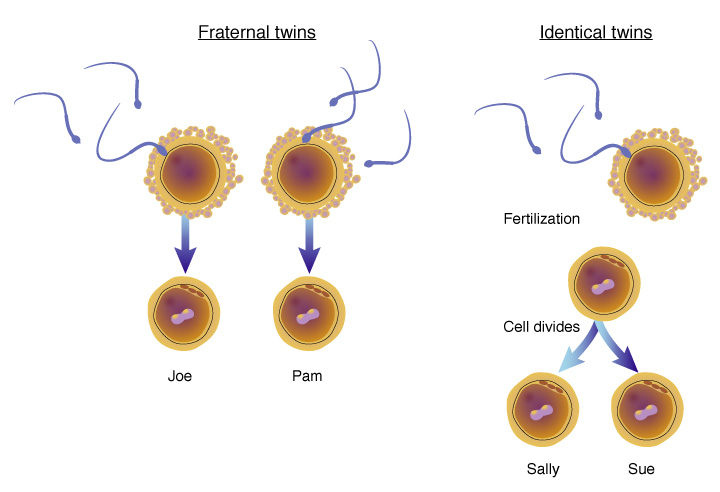
Twin designs build a natural “experiment” into human development. Monozygotic (MZ) twins are (nearly) genetically identical; dizygotic (DZ) twins share, on average, ~50% of segregating genetic variation—yet both sets typically share the same home at the same time.
Figure 4.1. Identical (monozygotic) and fraternal (dizygotic) twins differ in how they develop from fertilized eggs. Source: National Human Genome Research Institute (NIH). Public domain.
If a trait is influenced by genes, monozygotic (MZ) twins should be more similar than dizygotic (DZ) twins on that trait. By comparing correlations between MZ and DZ twins, researchers can partition sources of variation into three components:
A (Additive genetic): The portion of population-level variation attributable to additive genetic differences.
C (Shared environment): Environmental influences that make siblings raised in the same family more similar.
E (Non-shared environment and measurement error): Environmental influences that make siblings different from one another, including individual experiences and measurement error.
Across thousands of studies and many traits, MZ twins are consistently more similar than DZ twins. This pattern provides robust evidence for genetic influences on behavior, including substance use initiation and externalizing tendencies (Dick, 2021).
Landmark research on twins reared apart, such as the Minnesota Study of Twins Reared Apart (Bouchard et al., 1990), further demonstrates that genetic similarity predicts behavioral similarity even when environments differ. Despite being raised in separate households, these twins often showed striking similarities in hobbies, interests, and mannerisms, reinforcing the role of inherited factors alongside environmental influences.
Figure 4.2. Twin studies compare identical and fraternal twins to estimate genetic and environmental contributions to behavior using the ACE model.
Heritability
What heritability is—and isn’t
Heritability (often written h²) is a population-level statistic: the proportion of variation among people in a specific population, at a specific time, in a specific range of environments, that can be attributed to genetic differences. It ranges from 0 to 1 (0%–100%). Importantly:
Not about individuals. A heritability of 50% does not mean “half of your trait is genetic.”
Not immutability. High heritability does not mean environments don’t matter or can’t change outcomes. Genes are not destiny.
Not universal. Change the population or environments and heritability can change (it is context-dependent).
Not about group differences. Heritability within a group cannot explain between-group differences across contexts.
How heritability is estimated
Twin correlations provide an intuitive path to estimating A, C, and E using classic “Falconer” equations:
h² (A) ≈ 2 (r_MZ − r_DZ)
C ≈ 2 r_DZ − r_MZ
E ≈ 1 − r_MZ
Where r_MZ and r_DZ are the MZ and DZ twin correlations for a trait. These are back-of-the-envelope decompositions that communicate the idea: the more MZ twins out-correlate DZ twins, the more variance is attributable to genetic differences. Modern studies extend beyond these simple formulas (e.g., structural equation models; measured environments; genomic methods), but the central logic remains: relative similarity across levels of genetic relatedness informs A/C/E.
Quick example (thought experiment):
If r_MZ = 0.60 and r_DZ = 0.30, then
A ≈ 2(0.60 − 0.30) = 0.60;
C ≈ 2(0.30) − 0.60 = 0.00;
E ≈ 1 − 0.60 = 0.40.
Interpretation: substantial additive genetic influence in this population/context, with non-shared environments also important, and little shared-environment effect for this trait under these conditions.
The ABCD Twin Sample
ABCD Study intentionally oversampled twins at four sites with established twin registries and expertise (University of Colorado Boulder, University of Minnesota, Virginia Commonwealth University, Washington University in St. Louis) using state birth records and standardized recruitment (Iacono et al., 2018). The twin subsample includes 772 same-sex twin pairs (N = 1,544 youth) enrolled at ages 9–10 at baseline. Zygosity (MZ vs DZ) was inferred from genomic markers (e.g., the Smokescreen array; Uban et al., 2018), not just appearance, improving classification accuracy. The twin cohort—while broadly similar to the full ABCD sample—tends to include families with somewhat higher parental education and income and lower racial/ethnic diversity (Iacono et al., 2018). All procedures were IRB-approved (Auchter et al., 2018), with parental consent and child assent.
Defining the Pathways
Internalizing (inward-directed distress). Internalizing reflects patterns of negative affect that are directed inward, including anxiety, depressed mood, social withdrawal, and persistent worry. In the context of addiction risk, a common pathway involves self-medication, in which individuals use alcohol or other substances to reduce distress or to feel “normal.” Internalizing is not directly observed as a single behavior; instead, it is a latent construct inferred from symptom scales, self-report measures, and observed patterns of emotional functioning.
Externalizing (outward-directed disinhibition). Externalizing reflects behavioral disinhibition, including impulsivity, rule-breaking, oppositional behavior, and sensation seeking. These tendencies increase addiction risk through earlier initiation, greater experimentation, and difficulty inhibiting use in tempting or high-risk contexts. The classic marshmallow test, introduced earlier in the course, provides a simple illustration of delay of gratification—a core self-control process closely linked to externalizing liability.
Figure 4.3. Behaviors Exist on Continuums, Rather Than Binary Yes/No Diagnosis. There is Always a “Grey Area.”
Continuums, Not Boxes
Both internalizing and externalizing pathways exist on continuous dimensions, not as discrete categories. Individuals vary along a range of tendencies, while clinical diagnoses typically reflect the extreme ends of these distributions. What is inherited is liability—tendencies in how the brain processes emotion, reward, and self-control—not a guaranteed disorder. Environmental contexts and lived experiences strongly influence whether, when, and how this liability is expressed.
Two Short Vignettes
Vignette A: Internalizing → Self-Medication J., a 16-year-old with chronic social anxiety, dreads parties but wants to feel connected to peers. Before a gathering, J. discovers that two shots of alcohol quiet the heart-pounding and racing thoughts. The relief is immediate and powerful. Over time, the behavior repeats and escalates. This negative affect–relief loop, characteristic of an internalizing pathway, increases risk for alcohol misuse.
Vignette B: Externalizing → Early Initiation and Escalation M., a 15-year-old high in sensation seeking and impulsivity, gravitates toward older peers who vape and experiment with cannabis. Rules feel like challenges rather than constraints. The combination of novelty seeking, peer deviance, and weak inhibitory control nudges M. toward earlier initiation and riskier substance use trajectories.
Figure 4.4. Internalizing and externalizing pathways represent different, overlapping routes through which emotional and behavioral patterns can influence substance use risk.
Measurement: How Internalizing and Externalizing Are Operationalized
Internalizing and externalizing are latent constructs. Researchers infer them from patterns in multi-informant self-report surveys and from performance on behavioral tasks. The ABCD Study uses a youth, parent or guardian, and teacher design, along with a neurocognitive battery, to triangulate tendencies linked to substance use risk.
Multi-Informant Surveys (Youth, Parent or Guardian, Teacher)
Self-reports capture subjective experience (for example, persistent worry or urges during emotional distress) and habitual tendencies across everyday contexts. Parent or guardian and teacher reports add external observations of frequency, pervasiveness, and impairment across home and school.
Youth surveys
Examples only. See Appendix M4-A for the full list and ABCD table names.
Internalizing: Short-form indices of anxiety and depression; emotion regulation strategies (for example, ERQ); peer victimization (PEQ–Victimization); positive affect (NIH Toolbox).
What it measures. Five facets tied to externalizing routes: Negative Urgency (rash action under distress), Positive Urgency (rash action under excitement), Lack of Premeditation, Lack of Perseverance, Sensation Seeking.
Why it matters. These facets map cleanly onto early initiation, binge-prone episodes, acting without thinking, adherence/cessation challenges, and novelty-driven experimenting.
How to read it. Elevations in urgency often co-travel with coping-motivated or emotionally charged use; premeditation/perseverance link to planning and follow-through; sensation seeking highlights peer/novelty exposure risk.
Neurocognitive Tasks (Objective Performance)
Neurocognitive tasks translate latent capacities into observable performance. These capacities include inhibitory control, selective attention, working memory, and reward-based decision-making. Tasks are standardized, brief, and repeatable, which supports the study of individual differences and developmental change over time. The ABCD Study relies on the NIH Toolbox and companion tasks to assess key domains using age-normed scoring and consistent administration (see Appendix M4-B for an expanded list).
Typical domains sampled include:
Inhibitory control and attention (for example, Flanker)
Cognitive flexibility and set-shifting (for example, Dimensional Change Card Sort)
Working memory (for example, List Sorting)
Processing speed (for example, Pattern Comparison)
Episodic memory (for example, Picture Sequence Memory)
Language (for example, Picture Vocabulary, Oral Reading)
Decision-making and reward (for example, Delay Discounting or “cash-choice”)
How Task Performance Relates to the Pathways
Externalizing (disinhibition, early initiation). Tasks that probe response inhibition and top-down control are most proximal to externalizing liability.
Inhibitory control and attention (for example, Flanker): Larger conflict costs can indicate weaker control.
Reward valuation and impulsive choice (for example, Delay Discounting): Steeper discounting can indicate a stronger preference for immediate rewards.
Internalizing (distress, self-medication). Internalizing is not a single cognitive deficit. However, tasks indexing control, set-shifting, and working memory can inform regulatory capacity, meaning the skills people use to manage negative affect. Subjective distress is still best captured through self-report. Tasks complement surveys by indexing the capacity to regulate, not the presence of distress.
Cognitive control and flexibility (for example, Flanker, Dimensional Change Card Sort): Stronger control and flexibility may buffer the move from distress to substance use.
Working memory: Supports planning and coping strategies that can compete with self-medication.
Composites and Reliability
Single tasks can be noisy. Researchers often use composite scores (for example, executive-function factors) or latent variables to improve reliability before linking cognition to substance use outcomes.
Construct: Trade-offs between smaller-sooner vs larger-later rewards index impulsive choice and future valuation.
Outputs: Discount rate (k) or indifference points summarize how steeply value falls with delay.
Why it matters. Steeper discounting aligns with externalizing routes (earlier experimentation, difficulty with cessation) and can interact with stress/distress in internalizing contexts (using the immediate relief).
Construct. Report the direction of a central arrow while ignoring conflicting flankers; taps inhibition and selective attention.
Outputs. Conflict costs in accuracy and reaction time (incongruent − congruent).
Why it matters. Larger costs indicate weaker top-down control, a core feature of disinhibition in the externalizing pathway; stronger control may help buffer internalizing-driven urges.
We’ve now operationalized internalizing/externalizing with surveys (youth, parent, teacher) and tasks (objective performance). But genes never act alone. How do genes and environments work together to amplify, mute, or channel these pathways? Next: gene–environment interaction (G×E) and gene–environment correlation (rGE).
The Interplay: Gene–Environment Interaction (GxE) and Gene–Environment Correlation (rGE)
We have seen how inherited liability can manifest as internalizing and externalizing tendencies, measured using behavioral tasks and questionnaires. However, genes do not act in isolation. Environments shape, channel, and sometimes co-produce how genetic liability is expressed. Two core concepts help describe this interplay: gene–environment interaction (GxE) and gene–environment correlation (rGE).
Why “Genes and Environments” Is the Right Question
Genes are not destiny. Both genetic predispositions and environmental exposures are latent constructs. They are not directly observed, but instead inferred from indicators such as SNP profiles, neighborhood characteristics, or survey scales, and then modeled statistically.
With this framing in mind:
Gene–Environment Interaction (GxE): The magnitude or direction of genetic effects depends on the environment. The same genetic liability can lead to different outcomes in different contexts.
Gene–Environment Correlation (rGE): Individuals’ genetic tendencies influence the environments they are likely to experience, seek out, or evoke. This can occur through parental environments, others’ responses, or a person’s own choices.
These two processes are conceptually distinct but often occur together in real-world settings.
Gene–Environment Interaction (GxE): When Context Turns the Dial
Gene–environment interaction is present when the effect of genetic liability on a trait changes across levels of environmental exposure. For example, the association between externalizing liability and substance use may differ depending on neighborhood adversity or school support. Visually, this can be represented as two lines relating genetic liability to outcomes: one for low adversity and one for high adversity. If the slopes of these lines differ, this indicates a gene–environment interaction.
Figure 4.5. Gene–environment interaction (G×E): the association between genetic liability and an outcome can be stronger in adverse contexts and weaker in supportive contexts.
Illustration A: Adversity Amplifies Externalizing Liability Consider adolescents with varying levels of disinhibitory liability. In lower-adversity settings, such as stable housing, consistent rules, and pro-social peers, this liability predicts only modest risk for rule-breaking and early substance use. In higher-adversity settings, including unsafe neighborhoods, erratic supervision, and deviant peer norms, the same liability shows much steeper associations with early initiation and escalation. Context, in effect, turns up the volume on the genetic signal.
Illustration B: Advantage Amplifies Positive Neurodevelopmental Expression Now shift the lens to cognitive and brain development. In enriched environments, such as higher school quality, greater cognitive stimulation, and better access to healthcare, heritability estimates for outcomes like white-matter integrity or cognitive performance may appear higher. This does not mean the environment “does not matter.” Instead, supportive contexts allow genetic potential to express more consistently. In constrained environments, variation due to deprivation dominates; in enriched settings, genetic differences account for more of the remaining variation.
Take-home. Gene–environment interaction is not about “genes only mattering in bad places” or environments erasing genetics. Contexts tune how strongly genetic differences show up in behavior and development.
Gene–Environment Correlation (rGE): How Liability Steers Experience
Gene–environment correlation occurs when genetic tendencies and environments are correlated because genes help shape the environments a person receives, evokes, or seeks out. Three common forms are especially relevant.
Passive rGE. Parents provide both genes and home environments. For example, parents with higher executive function may create structured, enriched households. Children inherit related predispositions and grow up in routines that reinforce those traits.
Evocative (reactive) rGE. Individual traits elicit responses from others. For example, a youth high in sociability or disinhibition may receive more invitations to risky gatherings or, alternatively, more monitoring from adults, thereby altering their peer and supervision environment.
Active (selective) rGE. Individuals choose contexts that fit their tendencies. For example, a teen high in sensation seeking may gravitate toward novelty-rich peer groups and settings where experimentation is normalized, increasing opportunities for early substance use.
Family-history tie-in. Recall the family-history proxy discussed in Section 2. While useful, it blends heredity and shared environment, which captures the core intuition behind passive rGE: families transmit both genomes and contexts.
Figure 4.6. Gene–environment correlation (rGE): How genetic liability can shape exposure to environments. Examples illustrate passive rGE (parents provide both genes and home context), family history as a blend of heredity and context, evocative rGE (traits elicit responses from others), and active rGE (people select environments that fit predispositions). Blue = genetic liability; green = environments; purple = experiences/outcomes.
Because gene–environment correlation (rGE) can mimic environmental effects, meaning genes can influence which settings people experience, researchers often rely on designs that help separate genetic propensity from exposure effects.
Discordant twin comparisons (especially MZ). If genetically identical twins are exposed differently, for example, one initiates heavier substance use earlier while the other does not, and researchers later observe divergent cognitive or behavioral outcomes, this strengthens the case that the exposure itself contributed above and beyond shared genes and shared family background.
Adoption designs and measured-environment twin models. These approaches can sharpen inference by breaking the gene–home link (adoption) or by explicitly modeling measured environments alongside A/C/E components.
Caution. Even these designs require careful attention to timing (exposure precedes change), measurement error, and unmeasured twin-specific experiences. Still, they are major steps toward identifying environmental leverage points.
Putting it all together. The story is not “genes or environment,” but a dynamic, reciprocal system unfolding across development. In the next section, we synthesize these ideas, highlight ethical communication, and preview how molecular tools (GWAS and PGS) connect to the behavioral story developed so far.
Synthesis and Bridge to Molecular Genetics
What We Learned in Module 4
Across this module, we moved from resemblance to estimates. Family, adoption, and twin designs translate patterns of similarity into A/C/E components, and Falconer-style logic provides an intuitive interpretation of additive genetic influences (A), shared environment (C), and non-shared environment (E).
A central theme is that heritability is not destiny. Heritability is a population statistic that can vary by time, place, and context. It does not imply determinism for any individual and does not explain between-group differences.
We then translated inherited liability into two continuous behavioral pathways. Internalizing (distress leading toward self-medication) and externalizing (disinhibition leading toward early initiation) are latent constructs. They are inferred rather than directly observed, and they interact with everyday contexts.
The ABCD Study operationalizes these pathways using multi-informant surveys (youth, parent or guardian, teacher) and neurocognitive tasks (for example, Flanker and Delay Discounting). Composite scores and latent-variable approaches can improve reliability relative to single indicators.
Finally, we emphasized interplay rather than isolation. Gene–environment interaction (G×E) describes how context tunes the expression of genetic liability, while gene–environment correlation (rGE) describes how liability steers the environments people receive, evoke, or select. In practice, these processes often co-occur. Designs such as discordant twin comparisons, especially among MZ twins, help separate exposure effects from inherited propensity when timing and measurement are handled carefully.
Practical Implications for Study Design and Interpretation
In practice, begin by defining constructs clearly, for example, inhibitory control, urgency, or peer deviance, and then map them to specific ABCD tables and measures. Where appropriate, prefer composites or latent factors, such as executive-function composites, to reduce noise before linking predictors to outcomes.
Align measurement timelines so exposures precede changes, and leverage longitudinal waves and twin or sibling contrasts when available. Treat family history as a useful, low-cost clue to elevated liability, not a verdict, because it blends heredity with shared context and can motivate rGE-aware models. Throughout, use cautious causal language and reserve stronger claims for designs that reduce confounding, including discordant twins, adoption, and measured-environment twin models.
Looking Ahead: From Behavioral Inference to Molecular Evidence
Module 4 established that genetic influence exists and that it interplays with environments across development. Module 5 asks which genomic variants are associated with addiction-relevant traits and how to summarize many tiny effects.
Genome-wide association studies (GWAS) scan the genome to identify small associations, often involving thousands of variants with very small effects. Polygenic scores (PGS) aggregate these effects into a single index of inherited liability. PGS can support mechanism tests, including G×E, and inform study planning, with the reminder that these scores shift probabilities rather than determine outcomes.
We will also address key limitations, including portability across ancestries and the relatively small variance explained, and conclude Module 5 with a consolidated ethics section focused on privacy, consent, communication, and equity.
Appendix 1: ABCD Survey Instruments Measuring Internalizing and Externalizing
ABCD Internalizing and Externalizing Instruments
The ABCD Study employs a comprehensive set of instruments to measure internalizing and externalizing behaviors. These instruments are divided into Youth Instruments, Parent Instruments, and Teacher Instruments, providing a multi-informant perspective on the emotional and behavioral functioning of the participants.
The following instruments are completed by the youth participants themselves, offering direct insight into their own perceptions and experiences related to internalizing and externalizing behaviors.
Internalizing Instruments (Youth Report)
Table 4.1. Youth-report internalizing instruments in the ABCD Study (instrument names, ABCD table names, and brief descriptions).
Instrument Name
Table Name
Description
KSADS – Depressive Disorders
mh_y_ksads_dep
Assesses depressive disorders such as Major Depressive Disorder and Persistent Depressive Disorder in youth, evaluating symptoms like persistent sadness and loss of interest in activities.
KSADS – Generalized Anxiety Disorder
mh_y_ksads_gad
Evaluates symptoms of Generalized Anxiety Disorder in youth, including excessive worry and anxiety about various aspects of daily life.
KSADS – Social Anxiety Disorder
mh_y_ksads_sad
Assesses anxiety disorders such as Panic Disorder, Agoraphobia, Separation Anxiety Disorder, Specific Phobia, and Social Anxiety Disorder, focusing on fears and avoidance behaviors.
KSADS – Suicidality
mh_y_ksads_si
Measures suicidal thoughts, intentions, and behaviors in youth to assess risk and severity of suicidality.
KSADS – Eating Disorders
mh_y_ksads_ed
Assesses eating disorders including Anorexia Nervosa, Bulimia Nervosa, Binge Eating Disorder, and Other Specified Feeding or Eating Disorder, focusing on disordered eating behaviors and attitudes.
NIH Toolbox Positive Affect
mh_y_poa
Evaluates positive emotional states like contentment, happiness, enthusiasm, joy, and excitement experienced by the youth in the past week.
Brief Problem Monitor (ASEBA) – Internalizing Scale
mh_y_bpm
Measures internalizing problems such as anxiety, depression, and somatic complaints based on youth self-report, providing insight into emotional functioning.
Emotion Regulation Questionnaire (ERQ)
mh_y_erq
Assesses youth’s typical use of emotion regulation strategies, specifically cognitive reappraisal and expressive suppression, which relate to managing and responding to emotional experiences.
Peer Experience Questionnaire – Victimization
mh_y_peq
Evaluates experiences of being victimized by peers, including overt victimization (e.g., physical aggression) and relational victimization (e.g., social exclusion), which can contribute to internalizing problems.
Prodromal Psychosis Scale
mh_y_pps
Measures self-reported psychotic-like experiences in youth, such as unusual thoughts or perceptions, which may indicate risk for developing psychosis-related disorders.
Externalizing Measures (Youth Report)
Table 4.2. Youth-report externalizing instruments in the ABCD Study (instrument names, ABCD table names, and brief descriptions).
Instrument Name
Table Name
Description
KSADS – Conduct Disorders
mh_y_ksads_cd
Assesses conduct-related disorders including Oppositional Defiant Disorder and Conduct Disorder, focusing on behaviors like aggression toward people or animals, destruction of property, deceitfulness, theft, and serious violations of rules.
KSADS – Disruptive Mood Dysregulation Disorder
mh_y_ksads_dmdd
Evaluates severe recurrent temper outbursts and persistent irritability in youth, characteristic of Disruptive Mood Dysregulation Disorder, which can impact functioning and relate to externalizing behaviors.
Modified UPPS Impulsive Behavior Scale
mh_y_upps
Measures various facets of impulsivity, including urgency, lack of premeditation, lack of perseverance, sensation seeking, and positive urgency, which are linked to externalizing behaviors and risk-taking.
Behavioral Inhibition/Approach System Scales (BIS/BAS) – BAS Scales
mh_y_bisbas
Assesses the Behavioral Approach System (BAS), evaluating motivational tendencies toward goal-directed behavior, reward responsiveness, drive, and fun seeking, which are associated with externalizing behaviors like impulsivity and sensation seeking.
Brief Problem Monitor (ASEBA) – Externalizing Scale
mh_y_bpm
Measures externalizing problems such as aggressive behavior, hyperactivity, and rule-breaking based on youth self-report, providing insight into behavioral regulation issues.
Cyberbullying
mh_y_cbb
Assesses youth’s experiences with cyberbullying, specifically focusing on perpetration behaviors such as sending mean messages or spreading rumors online, which are considered externalizing actions.
Peer Experience Questionnaire – Aggression
mh_y_peq
Evaluates youth’s engagement in aggressive behaviors toward peers, including overt aggression (e.g., hitting) and relational aggression (e.g., excluding others), contributing to an understanding of externalizing tendencies.
7-Up Mania Inventory
mh_y_7up
Assesses symptoms of mania in youth, such as elevated mood, increased energy, and hyperactivity, which can manifest as externalizing behaviors impacting functioning in various settings.
Parent Instruments: Internalizing and Externalizing Measures
Parents provide valuable insights into their child’s behaviors and emotional states through various instruments. These Parent Instruments help capture aspects of internalizing and externalizing behaviors from the caregiver’s perspective.
Table 4.3. Parent-report internalizing and externalizing instruments in the ABCD Study (instrument names, ABCD table names, and brief descriptions).
Instrument Name
Table Name
Description
Child Behavior Checklist (CBCL; ASEBA)
mh_p_cbcl
A parent-report measure assessing youth psychopathological syndromes, including internalizing and externalizing problems, and adaptive functioning.
Adult Self Report (ASR; ASEBA)
mh_p_asr
A self-report measure where parents report on their own psychopathological syndromes, which can provide context for understanding familial influences on the child’s behaviors.
Adult Behavior Checklist on Other Parent (ABCL; ASEBA)
mh_p_abcl
Completed by the primary parent about the other parent, providing information on parental psychopathology that may impact the child’s environment.
Kiddie Schedule for Affective Disorders and Schizophrenia (KSADS-COMP)
Various (mh_p_ksads_*)
A structured diagnostic interview where parents report on their child’s symptoms across a range of psychiatric disorders, including mood disorders, anxiety disorders, conduct disorders, and others.
Difficulty in Emotion Regulation Scale (DERS; Parent Version)
mh_p_ders
Assesses the youth’s emotion regulation across multiple domains, including awareness, acceptance of emotions, and ability to engage in goal-directed behavior and refrain from impulsive actions.
Early Adolescent Temperament Questionnaire (EATQ-R; Parent Version)
mh_p_eatq
Evaluates the youth’s temperament traits such as activation, attention, fear, frustration, inhibitory control, aggression, and depressive mood from the parent’s perspective.
Note. The KSADS-COMP includes multiple modules assessing specific disorders, each stored in different data tables (e.g., mh_p_ksads_dep for depressive disorders, mh_p_ksads_cd for conduct disorders). These modules provide detailed information on symptoms and diagnoses based on parent reports.
Teacher Instrument: Internalizing and Externalizing Measures
Teachers offer an additional external viewpoint on the child’s behavior in academic and social settings. The Teacher Instrument helps capture behaviors that may manifest differently in school environments compared to home settings.
Table 4.4. Teacher-report internalizing and externalizing instrument in the ABCD Study (instrument name, ABCD table name, and brief description).
Instrument Name
Table Name
Description
Brief Problem Monitor (BPM; ASEBA)
mh_t_bpm
A teacher-report measure assessing the youth’s internalizing, externalizing, and attention problems, providing insight into the child’s functioning in the school context.
Neurocognitive Assessments Used in the ABCD Study
The table below outlines key instruments used to measure neurocognition in ABCD. The assessments measure a wide range of neurocognitive processes, including attention, memory, executive functions, decision-making, and more, providing comprehensive insights into adolescent brain development and its relation to genetic and environmental factors.
Table 4.5. Neurocognitive assessments used in the ABCD Study (ABCD table names and neurocognitive processes measured).
Assessment Name (ABCD Table Name)
Description and Neurocognitive Processes Measured
NIH Toolbox (Cognition) ABCD Table: nc_y_nihtb
A comprehensive battery of seven tasks administered via iPad to assess various cognitive domains. Measures include: 1. Picture Vocabulary: Assesses language vocabulary knowledge, contributing to the Crystallized Composite Score. 2. Flanker Inhibitory Control & Attention: Measures attention, cognitive control, and inhibition of automatic responses; part of the Fluid Composite Score. 3. Picture Sequence Memory: Evaluates episodic memory and sequencing abilities; contributes to the Fluid Composite Score. 4. Dimensional Change Card Sort: Assesses executive function, set shifting, and flexible thinking; included in the Fluid Composite Score (administered at baseline only). 5. Pattern Comparison Processing Speed: Measures information processing speed; part of the Fluid Composite Score. 6. Oral Reading Recognition: Evaluates language, oral reading skills, and academic achievement; contributes to the Crystallized Composite Score. 7. List Sorting Working Memory: Assesses working memory and information processing; included in the Fluid Composite Score (administered at baseline and 4-year follow-up).
Cash Choice Task ABCD Table: nc_y_cct
A decision-making task where youth choose between a smaller immediate reward and a larger delayed reward, assessing impulsivity and valuation of future outcomes as a proxy for delay discounting.
Little Man Task ABCD Table: nc_y_lmt
Evaluates visuospatial processing flexibility and attention by having participants determine which hand a figure (the “little man”) is holding a suitcase, requiring mental rotation skills. Measures mental rotation and perspective-taking abilities.
Rey Auditory Verbal Learning Test (RAVLT) ABCD Table: nc_y_ravlt
Assesses verbal learning and memory through recall of a list of words over multiple trials and after delays. Measures episodic memory, learning capacity, and retention.
Wechsler Intelligence Scale for Children (5th Ed.) – Matrix Reasoning ABCD Table: nc_y_wisc5
Measures fluid intelligence and visuospatial reasoning using pattern recognition and completion tasks. Assesses non-verbal abstract problem-solving skills.
Delay Discounting Scores ABCD Table: nc_y_ddis
Assesses decision-making related to delayed rewards by presenting choices between smaller immediate rewards and larger delayed rewards across various time intervals. Measures impulsivity and preference for immediate gratification versus delayed benefits.
Emotional Stroop Task ABCD Table: nc_y_est
Measures cognitive control in the presence of emotional distractions by having participants categorize emotional words while ignoring conflicting emotional facial expressions. Assesses inhibitory control and interference resolution under emotional conditions.
Game of Dice Task ABCD Table: nc_y_gdt
Assesses decision-making under risk by asking participants to predict dice roll outcomes with varying probabilities and associated gains or losses. Measures risk-taking behavior and the ability to make advantageous decisions when probabilities are explicit.
Social Influence Task ABCD Table: nc_y_sit
Evaluates risk perception, propensity for risk-taking, and susceptibility to perceived peer influence by having participants rate the riskiness of scenarios before and after viewing supposed